- Best glare control
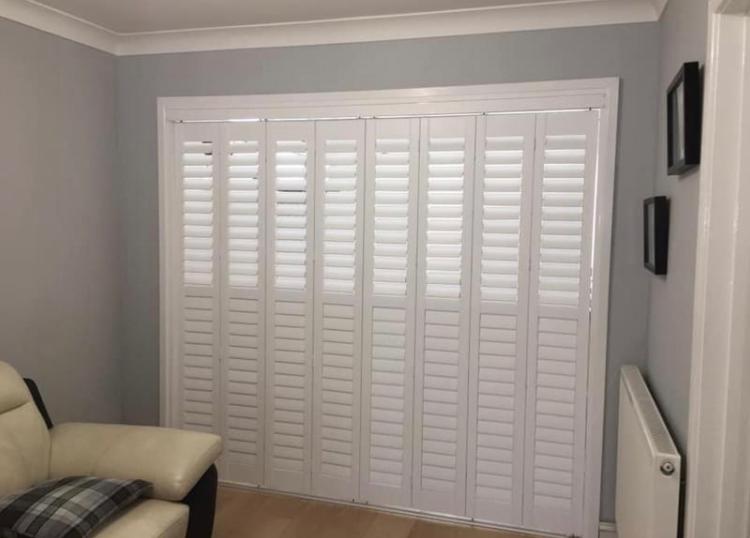
- Angled louvre shutters
- Budget option
- Light-filtering roller blind
- Prices
- Both priced on one survey
Quick answer
For a home office, the job is to stop sun hitting the screen while keeping enough daylight to work by. Shutters do this best, because you can angle the louvres to send light at the ceiling rather than the monitor; a light-filtering roller blind is the budget alternative. If you are on camera, keep the window behind you softly lit rather than bright.
Why offices need different window dressing
Living rooms are dressed for evenings; home offices are used through the brightest hours. A blind that is fully up leaves glare on the screen, and fully down leaves you working by lamp at midday. What an office needs is something in between that you can adjust as the sun moves, without getting up every half hour.
Shutters: adjustable light by angle
Tilting louvres up sends daylight towards the ceiling, where it spreads and lights the room evenly. Tilting them down blocks the view in from a pavement while still letting light through. For a desk that faces or sits beside a window, that range is hard to match with fabric. Larger louvres such as 89mm give the widest range of angle and a clearer view out when open.
On ground-floor offices at the front of the house, café-style shutters cover the lower half for privacy while leaving the top clear, which suits people who like to see the sky while they work.
Blinds: simple and lower cost
Blinds are the right choice when the budget is tight or the window is a secondary one.
- Light-filtering roller: softens bright sun and cuts glare, but you lose the view while it is down.
- Wooden venetian: tilting slats give some of the control of a shutter at a lower price.
- Vertical: suits a wide window or glazed door in a garden office.
- Blackout roller: only worth it if the office doubles as a guest bedroom.
Looking right on video calls
A bright window directly behind you turns you into a silhouette on camera. Closing shutters to a gentle angle, or lowering a light-filtering blind, evens the light so the camera exposes your face properly. Neutral colours sit quietly in the background; the frame of a shutter behind you also looks tidier than a half-drawn curtain.
Garden rooms and converted spaces
Many home offices are garden rooms or converted bedrooms with unusual glazing. Glazed doors suit vertical or roller blinds, while shaped or angled windows in a loft conversion can be shuttered to a template. We check reveal depth and handles on survey, because both decide whether a shutter or blind fits inside the opening or needs to be mounted on the face of the wall.
Next steps
A free home survey within 20 miles of Warrington lets us look at where the sun falls on your desk and price both options.
Home office questions
What is the best window covering for a home office?
Shutters give the most control, because angled louvres send light to the ceiling and away from the screen. A light-filtering roller blind is the budget choice.
How do I stop sun glare on my computer?
Diffuse the light rather than blocking it: tilt shutter louvres upward or lower a light-filtering blind, and avoid sitting with the window directly behind the screen.
Are shutters good behind me on video calls?
Yes. Angled louvres soften a bright window so the camera can expose your face instead of the sky.
Can you fit blinds in a garden office?
Yes, as long as it is within our area. Glazed doors usually suit vertical or roller blinds.