
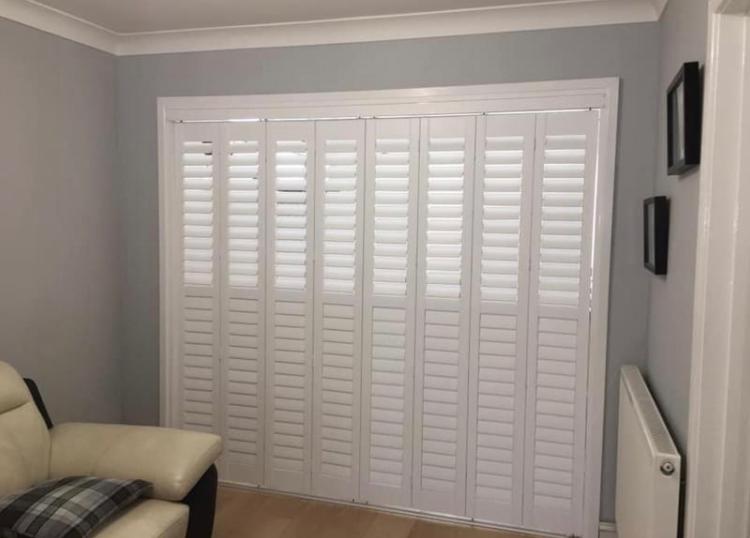
- Most fitted
- Full height, on roughly two thirds of windows
- Cheapest
- Café style, around 30 to 40% less than full height
- Dearest
- Tier on tier and shaped, 20 to 25% above full height
Quick orientation
There are six configurations of interior window shutter sold in the UK: full height, tier on tier, café style, solid panel, tracked (for doors and very wide openings) and shaped (for arches, circles and angles). They are all built from the same frames and louvres. The difference is purely in how the panels are arranged over the glass, and that arrangement should be chosen window by window rather than once for the whole house.
The six at a glance
The table below is the one we sketch on the back of a survey sheet when a customer asks for the differences in one place.
| Type | Covers | Best on | Price band |
|---|---|---|---|
| Full height | Whole window, one panel per section | Casements, standard sashes, most bays | Mid |
| Tier on tier | Whole window, two independent rows | Tall Victorian and Edwardian sashes | High |
| Café style | Lower half only | Street-facing ground floor windows | Low |
| Solid panel | Whole window, no louvres | Period sashes needing full blackout | High |
| Tracked | Doors and openings over about 3m | Patio doors, bifolds, room dividers | High |
| Shaped | Arches, circles, gables, rakes | Anything that is not a rectangle | Templated |
Full height: the default for a reason
A full height shutter is one panel per section running from cill to head. It is the simplest to make, the simplest to fit and the easiest to live with, which is why it accounts for most of what we install. The one decision within full height is whether to add a mid-rail. A mid-rail is a horizontal bar that splits the louvres into an upper and lower group with separate tilt, so you can close the bottom for privacy and leave the top open for light. On any window facing a pavement we would normally suggest one.
Tier on tier and café: the two front-room answers
Both exist to solve the same problem, which is a ground floor room where people walk past. Café style solves it cheaply by covering only the bottom half of the glass, leaving the upper half bare. You keep all the daylight from the top of the window but lose the ability to shade it, which matters on a south-facing bay in July.
Tier on tier solves it completely. Two separate rows of panels mean you can throw the top row open entirely and keep the bottom row closed, or close everything at night. It costs more because it is effectively two shutters in one frame, and it needs a window tall enough for the split to look intentional, which usually means a drop of around 1.5m or more.
Solid, tracked and shaped: the specialists
Solid panels have no louvres, so they behave like internal folding doors. They give the darkest room of any shutter and suit period sashes where the original Georgian or Victorian shutters were solid too. Tracked shutters hang from a top rail and glide or bi-fold rather than swinging, which is how we cover patio doors and openings too wide for hinged panels to stay square. Shaped shutters are made to a physical template taken at survey, and they are the only sensible way to dress an arched or circular window without leaving a triangle of bare glass.
Mixing types through one house
The most common mistake is choosing one type and applying it everywhere. A typical 1930s semi in Warrington might sensibly have café style on the front bay, full height with a mid-rail on the other front windows, plain full height at the back and waterproof full height in the bathroom. All of those can be ordered in the same colour and louvre size, so the house reads as one scheme from outside while each room gets what it needs.
Sorting out the terminology
Is a plantation shutter a type of window shutter, or the same thing?
In UK usage the terms overlap. Plantation shutter describes the wide-louvred interior style; window shutter is the broader term that also includes exterior timber shutters, which we do not fit. Every type on this page is an interior plantation shutter.
Which type is best for a bay window?
Full height with a mid-rail suits most bays. Tier on tier suits tall Victorian bays. Café style suits a bay where you want the top open all day. The bay itself is simply built from three or four sections of whichever type you pick.
Can tier on tier and café style be combined?
Not in one frame. If you like the look of café style but want the option to cover the top later, tier on tier gives you that, because you can leave the upper tier folded back most of the time.
Do tracked shutters work on bifold doors?
Yes, and they are usually the only shutter that does. The track sits above the doors and the panels stack to one or both sides so the doors can still fold fully open.