
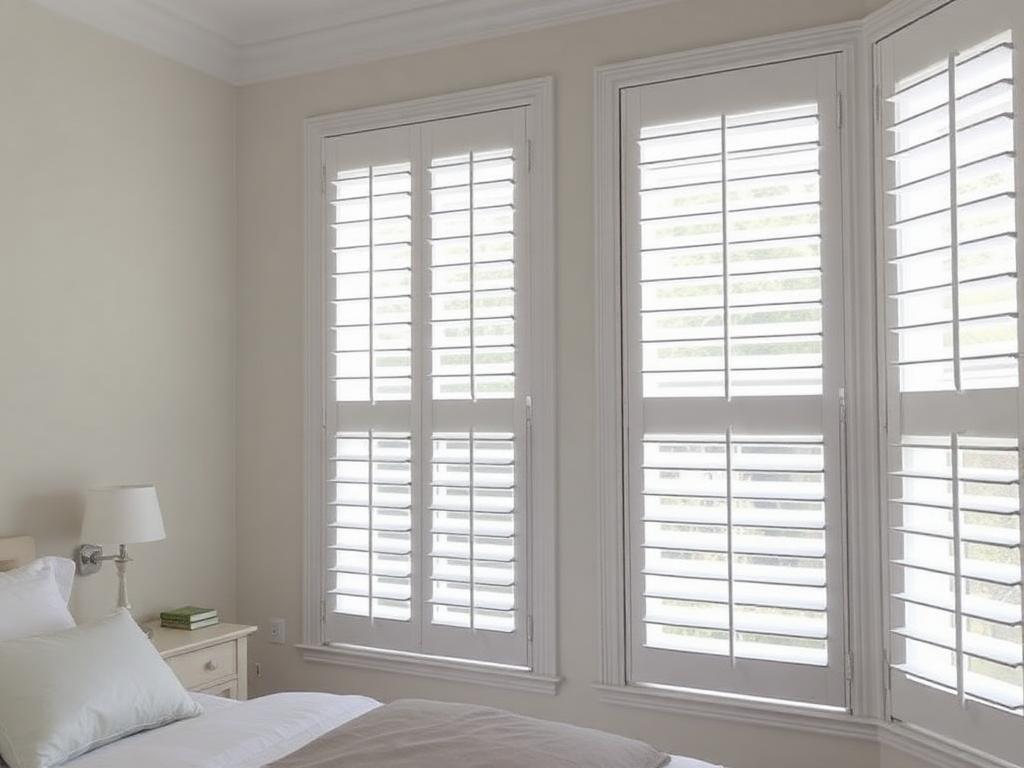
Not the same as a mid-rail
People often confuse tier-on-tier with a full-height shutter that has a mid-rail. A mid-rail is a horizontal bar across a single panel that lets you tilt the upper and lower louvres separately, but the panel itself still opens as one piece. With tier-on-tier the panels are genuinely separate: the top pair can be folded flat against the reveal while the bottom pair stays shut.
That difference matters most when you want the view as well as the light. Tilted louvres still put slats across the glass. Opening the top tier clears the upper window completely.
Why tall sash windows suit it
Victorian and Edwardian sashes are often well over two metres tall. A single full-height panel on a window that size is long and, when opened, swings a long way into the room. Splitting it into two tiers makes each panel shorter and lighter, and lining the split up with the sash meeting rail makes the shutter follow the window's own proportions.
It also suits how people use those rooms. A front bedroom on a busy road can keep the lower tier closed all day and open the upper tier for air and sky, which is something a single panel simply cannot do.
What it costs and why
Two rows of panels means more hinges, more framing and more making time, so tier-on-tier is typically 20 to 25% more than a full-height shutter on the same opening. Written quote after a free survey.
If the window is an ordinary height, a full-height shutter with a mid-rail usually gives you most of the benefit for less money. We will say so on the survey.
Things we check before recommending it
We also ask how you use the room through the day, because the style only pays off if you will actually open the tiers separately.
- Window height: tier-on-tier earns its cost on tall openings, less so on short ones.
- Where the split falls: ideally on the sash meeting rail or a strong glazing line.
- Room to open: each tier needs clearance for its panels to fold back.
- Recess depth: enough for the frame and for louvres to tilt without hitting the glass.
Timescale
Lead time confirmed when you order. Jonathan or Tony fit them in person, and we adjust the tension of each panel before we leave so every tier holds its position.
Using tier-on-tier through the day
The real payoff shows up in how a room is used hour to hour. In the morning you might fold both tiers right back for maximum light. By mid-afternoon, with the sun on the front of the house, you can close the lower tier and tilt its louvres upward to stop glare on the television, while the upper tier stays open to the sky. In the evening both close fully.
Each tier also has its own louvres, so even when a tier is shut you still decide how much light comes through it. That gives you four separate controls on one window: two sets of panels, two sets of louvres. For a street-facing bedroom or a lounge on a busy road, it is the most adaptable shutter we make, and people who choose it tend to use every one of those settings.
Key points
- Shutters from
- Written quote after a free survey
- Versus full-height
- Roughly 20 to 25% more
- Best on
- Tall sashes, double-height windows
Tier-on-tier, answered
What is the difference between tier-on-tier and a mid-rail?
A mid-rail splits louvre control on one panel; the panel still opens as one. Tier-on-tier has two separate sets of panels, so the top and bottom open independently.
How much more does tier-on-tier cost?
Roughly 20 to 25% more than full-height on the same window. Written quote after a free survey.
Is tier-on-tier worth it on a normal window?
Usually not. On standard heights a full-height shutter with a mid-rail gives similar control for less. It earns its keep on tall sashes.
Can I get it in waterproof ABS?
Yes, both our hardwood and waterproof ABS ranges can be made as tier-on-tier.