
Why acrylic
Solution-dyed means the colour is added to the fibre before it is spun, not printed or dyed onto the finished cloth, so it cannot wash out or bleach off the surface. The acrylic itself does not absorb water, so it dries quickly and is unfriendly to mildew. It is the standard on every awning we fit, and the fabric books are almost entirely acrylic ranges. Polyester is cheaper and found on budget awnings; it fades noticeably within a few seasons on a south-facing wall.
Plain or stripe
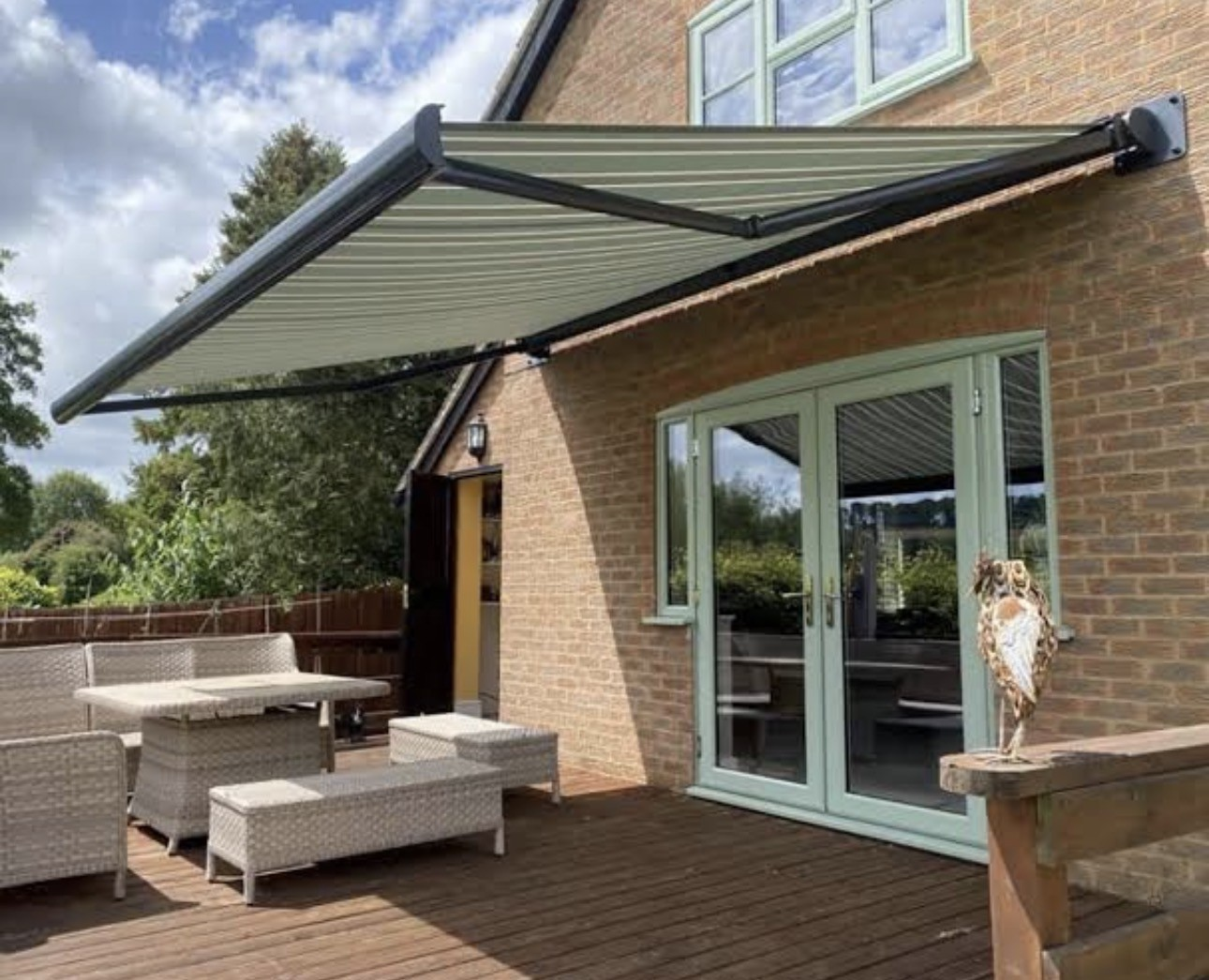
Stripes are the traditional awning look, and a narrow two-tone stripe still suits a period house or a seaside-style scheme. Plains have overtaken them on modern and rendered homes because they read as part of the architecture rather than a shopfront. A useful test is to imagine the awning retracted most of the year and extended on twenty summer afternoons: the fabric that looks right in both states, against the brick or render behind it, is the one to choose.
Light or dark
Dark fabrics, charcoal, navy, deep green, block more light and create a shade that feels cooler and more enclosed. They also hide dirt on the top surface but can show bird marks and pollen underneath. Light fabrics, cream, stone, pale grey, let more light through so the patio stays bright, and they reflect heat, but they show every mark on top. Mid tones are the practical middle ground and the reason so many awnings end up in taupe, grey or olive.
Frame colour
The cassette and arms are powder-coated aluminium, usually offered in white, anthracite grey and a range of colours to order. Match the frame to the window and door frames it sits above, not to the fabric. Anthracite on grey windows and white on white uPVC both disappear; a contrasting frame draws attention to the box rather than the shade.
Valance or no valance
A valance is the short skirt of fabric hanging from the front bar. It adds a little low-sun shade, softens the look and suits stripes and traditional houses. Leaving it off gives a crisp, contemporary line and one less thing to flap in a breeze. A drop-down front valance that unrolls a metre or more is a separate option for west-facing patios where evening sun comes straight in under the awning.
Looking after the fabric
Brush loose dirt off with a soft brush while the fabric is dry. Wash occasionally with lukewarm water and mild soap, rinse and let it dry fully extended before retracting. Never use a pressure washer, bleach or solvent, and never roll the awning away wet for more than a day or two; a full cassette protects the fabric when it is stored, not while it is damp. Treated this way, acrylic keeps its colour for many years.
Key points
- Fabric
- Solution-dyed acrylic, fade and mildew resistant
- Frame colours
- White, anthracite or matched to windows
- Care
- Soft brush and mild soap; never a pressure washer
Fabric questions
Will the fabric fade?
Solution-dyed acrylic is highly fade resistant, and colour loss over many years of direct sun is slight. Printed polyester fades far faster, which is why we do not fit it.
Is the fabric waterproof?
Acrylic is water-repellent and sheds light rain when the awning is pitched properly. It is not a roof; in heavy rain water can pool and the awning should be retracted.
Can the fabric be replaced later?
Yes. A re-cover on a sound frame is a routine job and a way to change colour or refresh an older awning without replacing the mechanism.
Do you have samples?
We bring fabric swatches to the survey and have larger samples in the showroom, so you can hold the colour against your wall in daylight.
Which colours show dirt least?
Mid greys, taupes and olives hide both surface dust and underside marks best. Very pale and very dark plains each show one or the other, so if the awning sits under trees or near a road, lean towards a mid tone.