
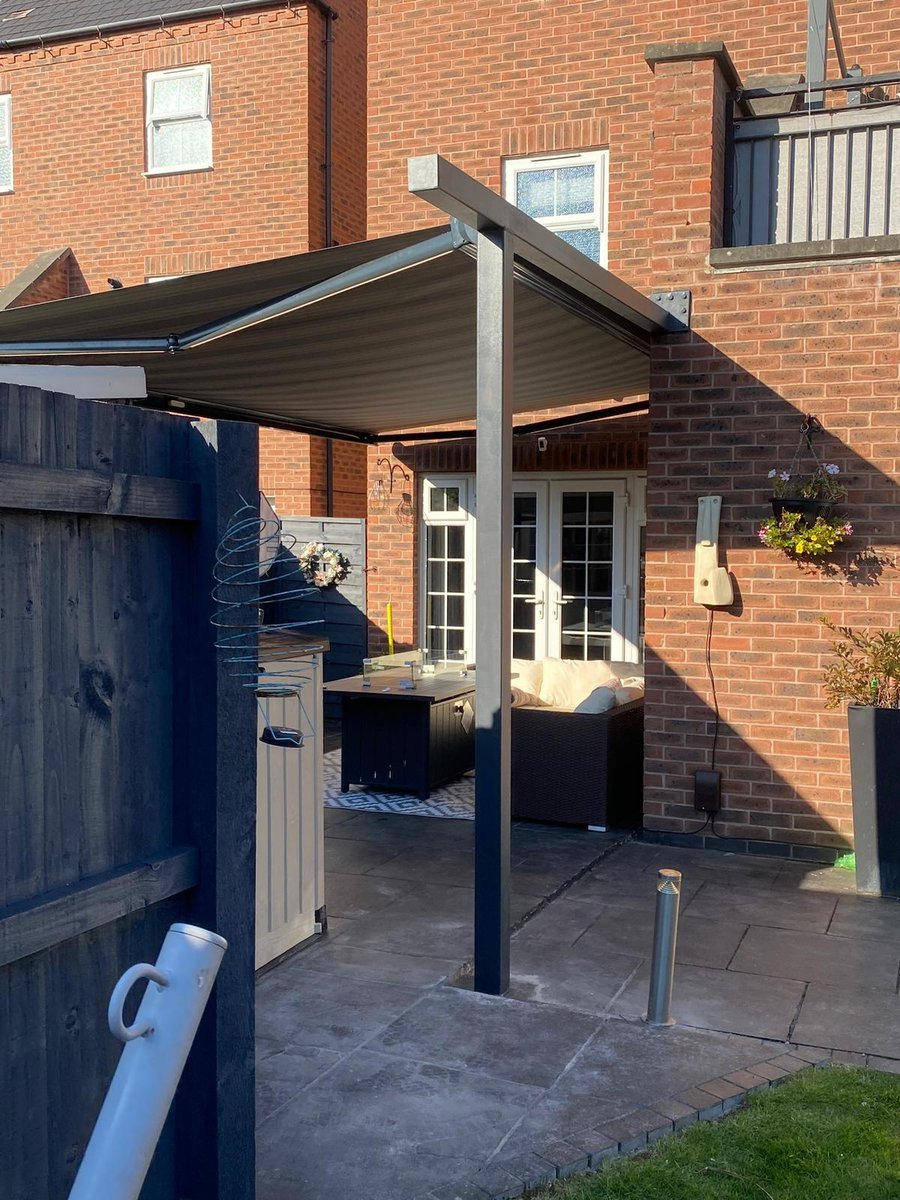
The short answer
A cassette awning is one whose fabric and folding arms retract into a closed box, so nothing is left exposed to rain, leaves or sunlight when it is rolled in. A full cassette encloses everything, a semi-cassette covers the top and front of the roll only, and an open awning leaves the fabric bare. For a UK patio where the awning stays up all year, a full cassette keeps it looking clean for longest; open designs cost least but age fastest.
- Full cassette
- Fabric and arms fully enclosed
- Semi-cassette
- Partial cover, lower cost
- Open
- Cheapest, fully exposed when retracted
Full cassette
The housing closes around the fabric and the folded arms, so nothing is exposed to rain, leaf litter or UV between uses. That is why a cassette awning still looks clean after several seasons while an open one has gone streaky along the roll.
It is also the tidiest on the elevation, a slim box rather than visible fabric and hardware.
Semi-cassette
A hood covers the top and front of the roll but leaves the underside open. It protects against most of the weather at a lower price and is a reasonable compromise for a sheltered elevation.
Under a first-floor overhang, semi-cassette often performs as well as full in practice.
- Exposed rear elevation, year-round, full cassette
- Sheltered patio under an overhang, semi-cassette
- Seasonal use, taken in over winter, open is defensible
- Commercial frontage, full cassette for appearance
Open awnings
The lowest cost and the shortest life outdoors. They are viable where the awning is genuinely sheltered or where the fabric is accepted as a periodic replacement item, but for most domestic patios the saving is repaid in a tired-looking awning.
Fixing and structure
Whatever the housing, the fixing carries the whole load in wind. Rendered walls, cavity construction and older brickwork each need the right bracket and fixing, and that is assessed on survey. A good awning on a poor fixing is a liability.
Common questions
What is a cassette awning?
An awning whose fabric and arms retract fully into a protective box, keeping them out of the weather between uses.
What does semi-cassette mean?
A hood covers the top and front of the rolled fabric but the underside stays open. It is a lower-cost middle ground that works well on sheltered patios.
Is a cassette awning worth the extra cost?
For an awning that stays up year round, yes, protecting the fabric and arms when retracted extends the whole unit's life and keeps it looking new.
Can an open awning be upgraded to a cassette later?
Not practically. The housing is part of the unit, so it is a decision made at purchase.
Do cassette awnings still need retracting in wind?
Yes. The cassette protects the fabric when closed; it does not make an extended awning wind-proof. A wind sensor handles the times you are not there.
What width should I choose?
Enough to shade the area you use, balanced against the exposure of the elevation. On windy sites a slightly smaller projection you actually deploy beats a large one you avoid using.