
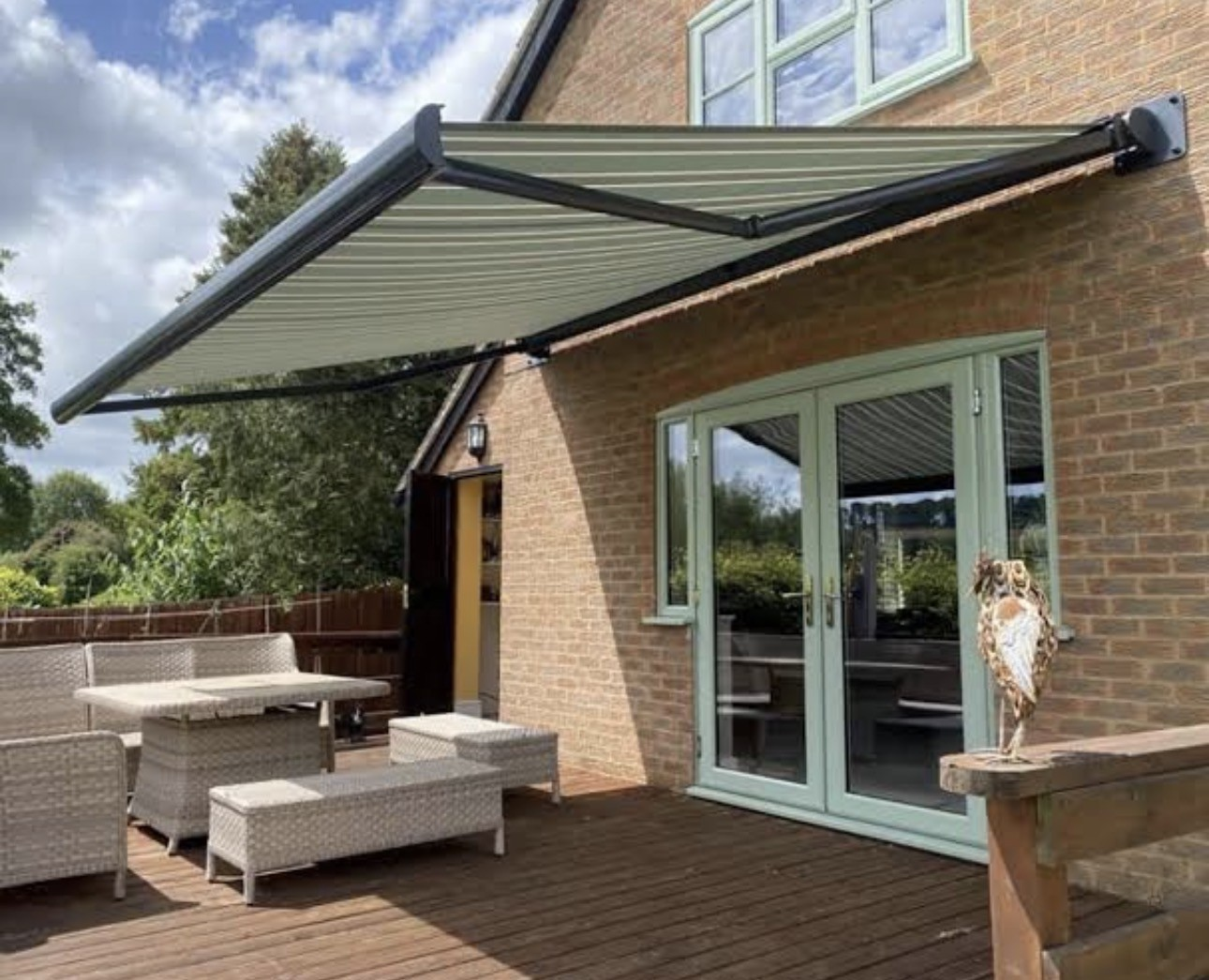
- Manual crank
- £1,400 to £1,900 fitted
- Somfy motorised
- £1,800 to £2,600 fitted
- Larger or LED cassette
- Up to £3,500
- Lead time
- 3 to 5 weeks either way
The short version
A manual crank awning is the cheaper buy and perfectly sound on a smaller patio, typically £1,400 to £1,900 fitted. A Somfy motorised awning with a remote is £1,800 to £2,600 fitted and earns that gap once the awning is wide, once it is used daily, or once you want a wind sensor to retract it while you are out. The deciding question is not budget, it is how often the thing will be wound out.
What you are actually choosing between
Both options are the same awning underneath: a roller tube, solution dyed acrylic fabric and spring loaded folding arms in a cassette. The difference is what turns the tube. A manual awning has a gearbox and a detachable crank handle that you hook into an eye and wind, perhaps twenty to thirty turns to run a mid sized awning out. A motorised one has a tubular Somfy motor inside the roller and a handheld remote, and takes about the same time without you standing there.
Where the price difference sits
Awnings start from £1,400 fitted. A typical 3.5m by 2.5m retractable cassette with a manual crank lands around £1,400 to £1,900 fully fitted. The same awning motorised with a remote and a wind sensor is around £1,800 to £2,600. Wider spans above 5m and full cassette versions with LED lighting can reach £3,500. Both routes include the survey, the wall fixings and the fitting, with no installation extras added afterwards.
Width and effort, the part nobody mentions in the showroom
Winding effort rises with the width and the arm tension, not with your enthusiasm. On a compact awning over a back door, a crank is a few seconds of work and completely fine. On anything much past three metres wide it becomes a job, and a job is what stops an awning being used on a bright but breezy Tuesday. The practical failure mode of a manual awning is not breakage, it is staying rolled up.
- Compact awning, occasional use, tight budget: manual is genuinely fine
- Wide span over patio doors, used most warm days: motorised
- Anyone who would rather not reach up with a handle: motorised
Sensors, and the safety argument for a motor
Sensors only exist on the motorised route, and this is the strongest reason to pay the difference. A wind sensor retracts the awning automatically in a gust, which protects the frame and, more to the point, the wall fixings it all hangs from. A sun sensor extends it when the patio warms up. Both pair with a smart hub for phone control, so an awning left out when you drive off does not stay out.
A manual awning has no way to protect itself. That is manageable if you are at home when it is out and disciplined about winding it in, and it is one reason we never recommend leaving any awning out overnight. Our wind and weather guide covers the ratings behind this.
Power supply and the fitting day
A motor needs a fused spur near the fixing point. If there is an outdoor socket or a convenient internal supply on that wall, it is straightforward. If there is nothing nearby, the electrical work is the variable, and we check it at the survey rather than discovering it on the day. A manual awning has no such requirement, which occasionally makes it the pragmatic choice on a detached wall, an outbuilding or a rear elevation with no power run.
Everything else about the installation is identical. The load goes into a handful of brackets, so solid brick is simple, cavity walls need resin anchors or through bolts, and render, cladding or timber frame each get their own method. Lead time is three to five weeks whichever operation you pick.
Living with each one over ten years
A crank gearbox is a simple mechanism with very little to go wrong, and the handle can be replaced for pennies if it wanders off into the shed. A motor is a sealed unit with an expected service life measured in thousands of cycles, and a remote that needs a battery every few years. Fabric care is the same for both: let it dry before rolling it away, brush off leaves, and keep the cassette clear.
Which is right for you
Pick manual if the awning is modest, the budget is firm, there is no power on that wall, or the patio is used occasionally rather than most weekends. Pick motorised if the span is wide, the awning will be out on most warm days, nobody in the house fancies winding a handle, or you want a wind sensor looking after it while you are at work. Where the honest answer is manual, that is what we will quote, and the same awning can be specified with a motor later only if the tube is suitable, so it is worth deciding before the order rather than after.
Questions before you pick an operation
Is a motorised awning worth the extra money?
On a wide awning used most warm days, yes, mainly for the wind sensor and because it actually gets used. On a small awning over a back door, a crank is sound and saves several hundred pounds.
How much more is motorised?
Roughly the difference between £1,400 to £1,900 fitted for a typical manual cassette and £1,800 to £2,600 fitted for the same awning with a Somfy motor and remote.
Can a manual awning be motorised later?
Only if the roller tube suits a retrofit motor, and there is still the power supply to run. It is cheaper and tidier to decide before the order.
What happens to a motorised awning in a power cut?
It stays where it is. This is one reason we fit wind sensors, so the awning is unlikely to be out in the weather that causes the cut in the first place.
Does a motor need an electrician on the day?
It needs a fused spur near the fixing point. We check what is already on that wall at the survey so the supply is sorted before fitting day.
Do both types come with a cassette?
We only fit full cassette systems, where the fabric and arms close inside an aluminium housing when retracted, because that is what survives a North West winter.