
The short answer
Short answer: external shutters change how the building looks from the street, which is exactly what planning and conservation area controls cover, so speak to your council before fitting them. Internal shutters do not change the outside of the building, so in the great majority of cases no planning permission is needed and a conservation area alone is not a barrier. Listed buildings are the exception worth checking, because consent can cover internal fabric and fixings as well as the exterior.
- Conservation area
- Internal work is normally unaffected
- Listed building
- Check with the local authority
- Local councils
- Warrington, Cheshire East, Cheshire West
Conservation areas
Conservation area controls are about what the street sees: elevations, windows, doors, roofs and boundaries. Fitting shutters inside a room does not alter any of that, so for a normal internal installation there is nothing to apply for.
Where care is worth taking is appearance from outside. A crisp white shutter reads consistently across a terrace, whereas mixed colours across neighbouring windows can look untidy from the pavement.
Listed buildings
Listing protects internal fabric too, and shutters are fixed with screws into the reveal or the window joinery. Where the existing joinery is original, that is a genuine consideration, and the sensible route is a quick conversation with the conservation officer at your council before ordering.
We work within 20 miles of Stockton Heath (WA4 6LL), including parts of Cheshire East and Cheshire West and Chester, and can provide the specification and fixing detail in writing to support an enquiry.
Specifying sympathetically
In period rooms, smaller louvres and solid or raised panels usually sit better than large modern louvres. Face-fit frames can be avoided where the original architrave should stay visible, and hidden hinges keep the ironmongery quiet.
- Smaller louvre sizes for Victorian and Georgian rooms
- Solid or raised panels where original shutters once sat
- Recess fit to keep the architrave exposed
- Hidden hinges and a paint finish rather than a heavy stain
Rented and leasehold property
Shutters are a fixed installation, so a landlord's or freeholder's written permission is worth having first. Where that is not possible, we can suggest no-drill and tension-fit alternatives instead.
External shutters and planning permission
Shutters fixed to the outside wall become part of the elevation. On a house in a conservation area, or on any listed building, that puts them squarely in the territory the council controls, and the safe order is to ask before anything is ordered.
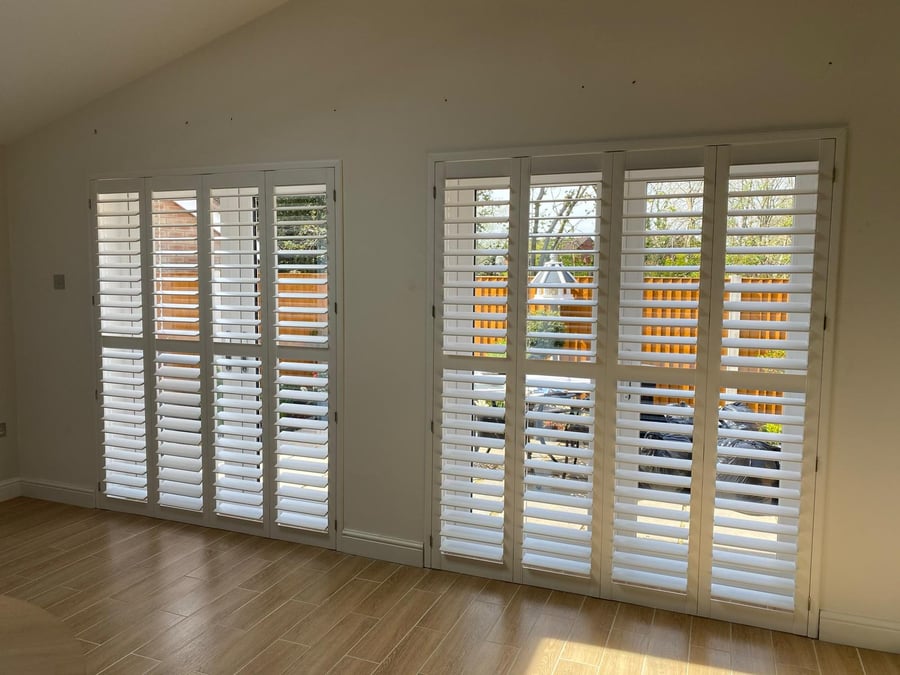
The shutters we make and fit are internal plantation shutters. They sit in the window reveal inside the room, so the street sees a tidy line of louvres behind the glass rather than a change to the facade. That is why most period owners who want the look without a planning conversation choose internal panels.
Common questions
Do external shutters need planning permission?
External shutters alter the outside of the building, so check with your local council first, particularly in a conservation area or on a listed building. Our shutters are internal, fitted inside the reveal, which normally avoids the question.
Is this legal advice?
No. It reflects how these jobs normally proceed. For a listed property, confirm with your local authority's conservation team before ordering.
Do I need consent for shutters in a conservation area?
For internal shutters, normally not, because the exterior of the building is unchanged.
Can shutters be fitted without drilling original joinery?
Often, yes, by fixing into the plaster reveal instead. We assess this at the survey.
Will you talk to my conservation officer?
We will supply the material specification, frame profile and fixing method in writing so you can submit it.