
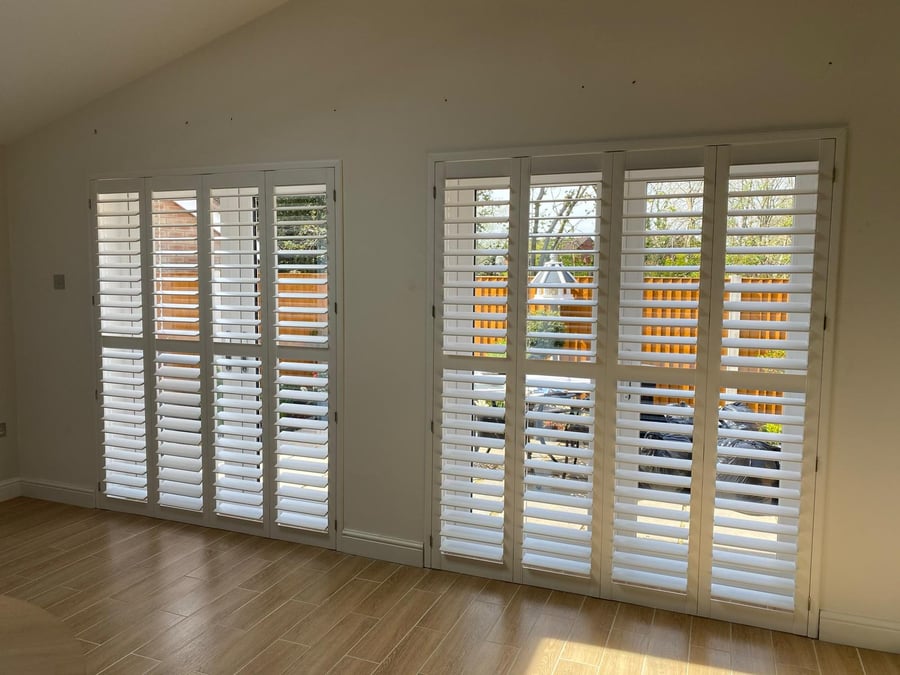
Before you choose wood
Wooden shutters are the lightest and most refined option for large or tall windows, and the only one that can be stained to show grain. They are not the best choice for bathrooms, kitchens with poor extraction or any window that gets regular condensation, where a waterproof ABS shutter will outlast them. Choose timber for living rooms, bedrooms, bays and period sashes; choose something else where water is involved.
What wood gives you that composite cannot
Three things. First, weight: a hardwood panel is noticeably lighter than an MDF-cored one of the same size, which means panels can be made wider before they start to drop on their hinges. On a tall Victorian sash that lets us use fewer, larger panels and fewer vertical lines across the glass. Second, finish: only timber can be stained, so if you want to see grain rather than paint, wood is the only route. Third, feel: the louvres have a crispness in the hand that a wrapped composite does not quite match.
Where timber struggles
Wood moves with moisture. In a normally heated and ventilated living room that movement is tiny and invisible. In a bathroom, a kitchen without a decent extractor, a utility room with a tumble dryer or a bedroom that suffers heavy condensation, timber shutters can swell, stick at the edges and eventually show hairline cracks in the paint at the joints.
That is not a defect; it is what wood does. It is why we steer bathroom and kitchen enquiries to waterproof ABS, which is a solid polymer that does not care about steam. Putting hardwood in a wet room to save a few pounds is a false economy.
Painted or stained?
Painted hardwood is the most popular specification we fit, usually in a white or off-white that matches the room's woodwork. A painted finish hides the joints between stiles, rails and louvres so the shutter reads as one clean object. Stained hardwood shows those joints as part of the look, and suits rooms with exposed timber floors, oak doors or a more traditional scheme.
One practical point: a painted shutter can be colour matched to an existing paint reference, and touch-ups years later are straightforward. A stained shutter is harder to match if you ever extend a scheme with new panels, because the timber batch and the way it takes stain will differ slightly.
Sizing rules that matter more in wood
Because you are paying for timber's ability to span, make the most of it. Ask about the maximum panel width for the range you are quoted rather than defaulting to narrow panels. Consider 89mm louvres on anything over about 1.2m tall; they suit the proportions of timber and give a more open view. And on bays, hardwood's stability over long runs is one of the few places where the premium over composite is easy to justify.
Cost and timescale
Hardwood sits above MDF-cored composite in price, with a standard window starting from £450 fitted and bays priced per section from around £950. Timber ranges are made to order and typically take six to eight weeks from survey to fitting. If you need something faster, the UK-made fast-track range is a composite rather than a timber product, so it is worth deciding early whether the grain or the calendar matters more.
Living with wooden shutters
Will wooden shutters warp?
In a dry, heated room, no. Quality hardwood shutters are built from engineered timber sections precisely to resist movement. In a steamy bathroom or a room with persistent condensation, any timber product is at risk, which is why we specify ABS there.
Can I paint wooden shutters myself later?
You can, but it is fiddly work on louvres and the factory finish is sprayed rather than brushed, so a hand-painted coat rarely looks the same. If you might change colour later, choose a painted range now and ask about re-spraying options.
Are wooden shutters heavier to open than composite?
The opposite. Timber is lighter than MDF-cored composite, so a hardwood panel swings more easily and puts less strain on its hinges over the years.
Do wooden shutters fade?
Stained timber on a south-facing window will mellow slightly over many years, as any wood does in sunlight. Painted finishes are far more stable. Neither should change noticeably within the first several years.
Is real wood better for insulation?
Marginally. Timber is a slightly better insulator than dense composite, but the bigger factor by far is how tightly the frame fits the reveal, which is the same for both.