
The short answer
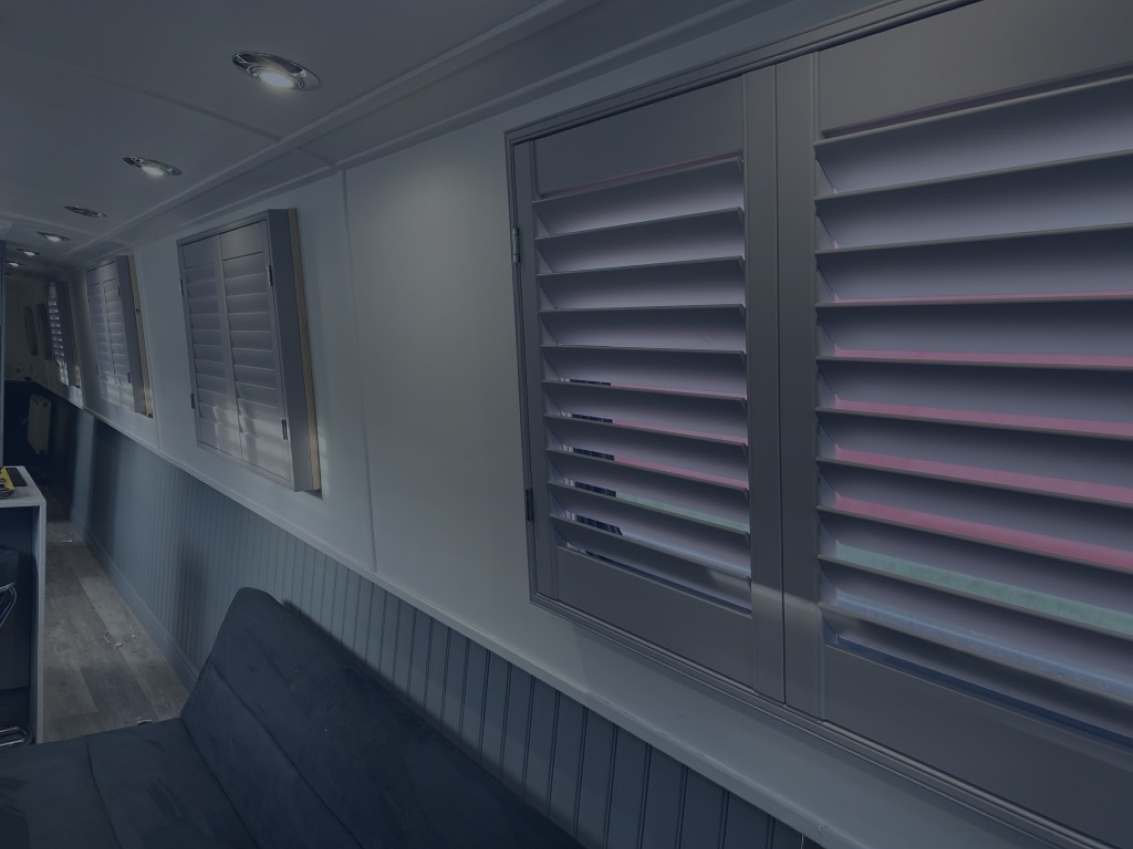
Short answer: fully open, a shutter costs you roughly 10 to 15 per cent of the glazed area, mostly to the frame and stiles rather than the louvres. That is less than a curtain stacked at the sides of most windows, and more than a roller blind pulled fully up.
- Light loss, louvres open
- About 10 to 15 per cent of the aperture
- Brightest option
- Wide louvres in a face fit frame
- Darkest option
- Solid panels, closed
Where the light actually goes
People assume the louvres are the problem. They are not. With the louvres tilted flat you are looking through a series of open slots, and the visible obstruction is the thickness of each blade, which on a 76mm louvre is a few millimetres.
The loss is in the frame and the stiles: the vertical edges of the panel, the mid rail if there is one, and the perimeter frame sitting inside your reveal. On a small window that perimeter is a much larger fraction of the aperture than it is on a large one, which is why small windows feel more affected.
Three choices that keep a room bright
If daylight is the priority, and it usually is on a north facing room or a small terrace kitchen, these are the specification decisions that matter.
- Choose a wider louvre, 89mm or 114mm rather than 47mm, so there are fewer blades and fewer stacked edges in the aperture
- Face fit rather than recess fit where the reveal is shallow, so the frame sits on the wall and not in the daylight
- Ask for a slimmer L frame instead of a deep box frame, which can give back 20 to 30mm of glass on each side
- Consider cafe style, which leaves the top of the window entirely unobstructed
How it compares with what you have now
Against full length curtains, shutters almost always win on daylight, because curtains stack 150 to 300mm over the glass on each side even when fully drawn back. Against a roller blind rolled fully to the head, shutters lose slightly, since the roller sits above the glass.
Against a vertical or venetian blind, it is close. A venetian with the slats open obstructs a similar amount, though the headrail typically takes more from the top of the window than a shutter frame does.
The other direction: making a room properly dark
A closed shutter is not blackout. Light passes at the louvre overlaps and around the panel edges, which suits most bedrooms but not a shift worker or a nursery in June. For genuine darkness we fit a blackout blind behind the shutter, so you keep the shutter for the look and the daytime control and the blind for the nights it matters.
Common questions
Do solid shutters make a room darker than louvred ones?
Yes when closed, because a solid panel has no louvre gaps. Open, the loss is mostly the frame and stiles, so the difference is small.
Will shutters make my north facing room gloomy?
Not if you specify for it. Wide louvres, a slim frame and a face fit installation keep the aperture close to what you have now, and the room feels brighter than it does behind curtains.
Do wider louvres really let in more light?
Yes, modestly. Fewer blades means fewer blade edges across the glass and a more open view when tilted flat. The visual difference is bigger than the measured one.
Are shutters blackout when closed?
No. They cut most of the light but not all of it. If you need a fully dark room, pair the shutter with a blackout blind behind it.
Does the frame have to sit inside the window recess?
No. Where the reveal is shallow or the daylight is precious, we face fit the frame onto the wall around the opening instead.