
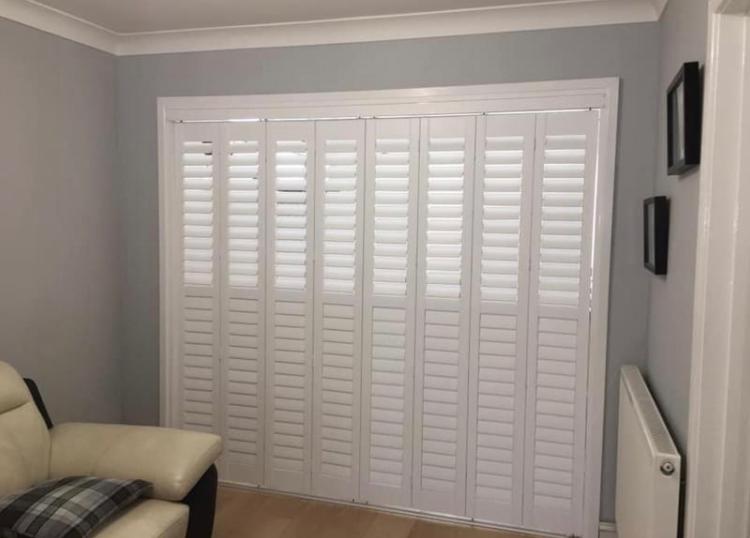
How louvres are linked
Louvres in a panel are connected so they tilt together. With a visible rod, each louvre is stapled or clipped to a vertical bar on the room side; move the bar, move the louvres. With hidden tilt, a slim metal linkage runs inside the panel's side stile and connects to each louvre pin, so the linkage is invisible and the louvres move as one when you tilt any single slat.
Centre tilt rod
This is the classic plantation look, with a slim bar running down the middle of each panel. It is what most people picture, it is robust, and on a very wide panel it gives a firm handle to tilt heavy louvres. Its drawbacks are visual: the rod interrupts the view when the louvres are open, and on a bay of three or four panels you get three or four vertical bars breaking up the outlook.
Offset tilt rod
The offset rod is the same bar moved to the hinge side of the panel, so it sits against the frame rather than across the view. It keeps the traditional detail while clearing the centre of the glass. It works particularly well on tier on tier and café style, where the rod at the edge lines up neatly with the frame.
Hidden tilt
Hidden tilt has become the most requested option on new orders because it looks the most modern and gives an uninterrupted view through open louvres. It also makes cleaning easier, with nothing on the face of the panel to work around. Practical notes: on very tall panels a mid-rail helps, because tilting forty louvres from one slat asks a lot of the linkage; and small children sometimes find it less obvious how to operate than a rod, which some parents count as an advantage.
Choosing across a whole house
Consistency matters within a room but not necessarily across the house. Many customers choose hidden tilt for the living room and bedrooms, where the view and the clean look matter, and a centre or offset rod in a period room where the traditional detail suits. If in doubt, handle all three in the showroom; the difference in feel is more obvious in the hand than in a photograph.
Split tilt and mid-rails
Whichever control you choose, ask about split tilt. A mid-rail, or a hidden split without a rail, lets the upper and lower louvres tilt independently, so the bottom half can be closed for privacy while the top stays open. On any ground-floor room facing the street it is the single most useful option on the order form.
Key points
- Centre rod
- Traditional look, visible bar down the middle
- Offset rod
- Same bar, moved to the hinge edge
- Hidden tilt
- No rod; push any louvre and all move
Control questions
Does hidden tilt cost more?
Some ranges include it as standard and some add a small charge per panel. It is not a major line on a quote, and we will show it either way so you can compare.
Is hidden tilt less reliable?
It has more moving parts than a simple rod, but the linkage is metal and enclosed inside the stile. Problems are uncommon, and when a louvre pin does wear it can be replaced without removing the panel.
Can I have a centre rod on some louvres and hidden on others?
Not within one panel. You choose one control per panel, though different rooms can have different controls if you prefer.
Which is best for someone with arthritis?
Usually an offset or centre rod, because it gives a solid bar to grip rather than the edge of a single louvre. We can talk that through at survey.
Can a tilt rod be replaced with hidden tilt later?
Not on an existing panel; the linkage is built into the stile during manufacture. If hidden tilt appeals, decide before ordering rather than planning to upgrade.
Does the control affect how dark the room gets?
No. Louvre closure is set by the louvre shape and overlap, not by the control. All three options close the louvres to the same angle.