
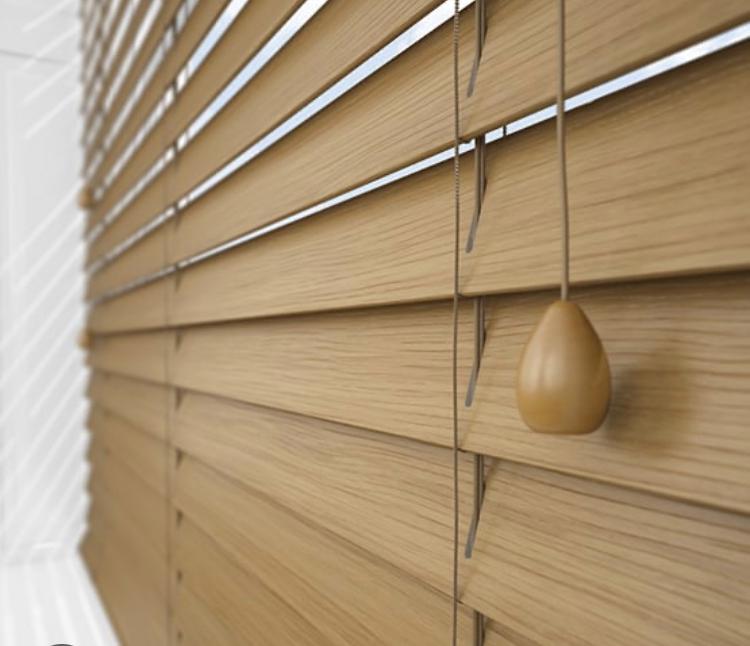
What slat width changes
Wider slats mean fewer of them, so the blind has fewer horizontal lines, a more open view when tilted, and a shorter stack of slats at the top when fully raised. They also need more depth: a 50mm slat tilted flat needs a recess of around 60mm to clear the glass and the handle. Narrower slats fit shallower recesses and suit smaller windows where 50mm would look oversized, but they stack taller and show more lines across the view.
50mm: the plantation look
The 50mm slat is what most people are picturing when they search for shutter blinds. On a window over about a metre wide it looks proportionate and generous, and with cloth tapes it reads as a solid, furnished piece rather than a utilitarian blind. It suits living rooms, dining rooms and main bedrooms. Its limits are depth, which rules out shallow uPVC recesses unless face fixed, and small windows, where it can look heavy.
35mm: the safe middle
The 35mm slat is the one we specify most often on standard bedroom and study windows around 800mm to 1,200mm wide. It fits most recesses, stacks reasonably, and looks neither dainty nor bulky. If you are unsure and the window is average sized, 35mm rarely disappoints.
25mm: small panes and tight spaces
The 25mm slat belongs on cottage windows, cloakrooms, narrow landing windows and anywhere the recess is shallow. It gives fine light control at close range and its small stack is an advantage on short windows. On a large window it produces too many lines and a lot of cord, so keep it for the openings it was designed for.
Tapes or cords
Every venetian is lifted by cords through holes in the slats. Cloth ladder tapes cover those holes with a strip of fabric on the front and back of the blind, which blocks the pinpricks of light through the holes and adds a second colour. They suit 50mm slats best and make the blind look more like a shutter. Cord ladders leave the slats visually lighter and are the usual choice on 25mm and 35mm. Neither is dearer by much; it is a look decision.
Real wood or faux-wood
Real basswood is lighter, so wide blinds lift more easily, and it has a natural grain that takes stain beautifully. Faux-wood, a PVC or composite slat, is heavier but does not mind steam or splashes, so it is the right choice in kitchens, bathrooms and utility rooms. Painted finishes look almost identical in both; the difference shows in stained finishes and in how heavy a very wide blind feels to raise. Prices for both sit in the £140 to £220 per window range fitted.
Key points
- 50mm
- Shutter look, best view, fewest slats
- 35mm
- Balanced choice for medium windows
- 25mm
- Small panes and shallow recesses
Slat questions
Which slat size looks most like plantation shutters?
50mm with cloth tapes. From across the room it is the closest a blind gets to a shutter, and it costs roughly a third of the price. Up close the headrail and cords give it away.
Can I mix slat sizes in one house?
Yes, and it is normal. Keep one size per room and per elevation where windows sit side by side, but a 50mm in the lounge and a 25mm in the cloakroom is perfectly sensible.
How much recess depth do I need?
Roughly 60mm for 50mm slats, 45mm for 35mm and 35mm for 25mm, measured to the nearest obstruction such as a handle. If the recess is shallower, the blind is face fixed to the wall above.
Do wooden venetians block light?
Closed slats block most light but never all of it; there are gaps at the edges and at the cord holes unless tapes are fitted. For a bedroom needing true blackout, pair with a blackout roller or choose a blackout system.